 |
 |
 |
|
|
|
Oxide Thickness Measurements
Several methods are used for the measurement of thermal oxide thickness. These include color, mechanical, interference, and ellipsometry.
Color - the easiest method for estimating oxide thickness is to observe the film under illumination by a white light. Uniform color is evidence of a uniform oxide thickness. The sensation of a single color is due to the absence of particular frequencies in white light. The missing frequencies are due to destructive interference as the light is reflected from the oxide-air interface.
Destructive interference occurs when
2d = (2k - 1)l /2n
where d is oxide thickness, k = 1,2,3 order, n = index of refraction of SiO2 film
Color Chart
| k=1 | 2 | 3 | |
| Grey | 100 A | - | - |
| Tan | 300 | - | - |
| Brown | 500 | - | - |
| Blue | 800 | - | - |
| Violet | 1000 | 2800 | 4600 |
| Blue | 1500 | 3000 | 4900 |
| Green | 1800 | 3300 | 5200 |
| Yellow | 2100 | 3700 | 5600 |
In the sectioning technique a wheel is used to grind a slot in the SiO2/Si sample. By using simple geometry, we can determine the actual thickness of the SiO2 layer
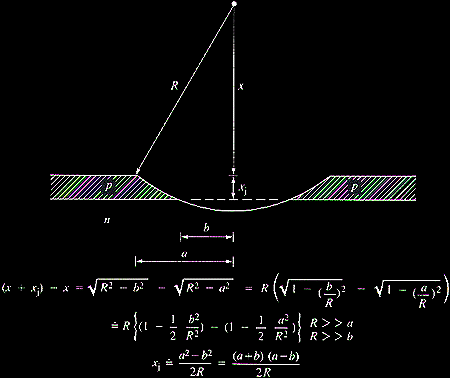
by knowing R, we can determine the thickness of the oxide.
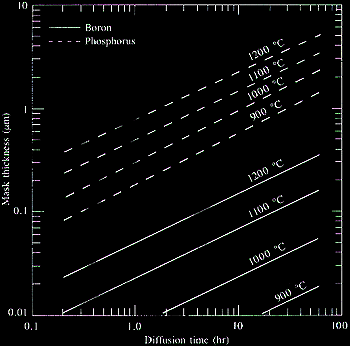
Masking Using SiO2
Because of large differences between impurities diffusion coefficiencies.
SiO2 can be used as an effective mask against diffusion.