 |
 |
 |
|
|
|
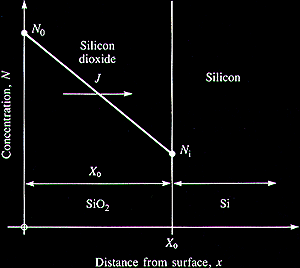
During the growth of SiO2 some of the silicon is consumed. This amount is given by:
Xsi : thickness of Si consumed
Xox : thickness SiO2 grown
Also
J = kNi ks interfacial reaction
rate constant
combine the above two equations.
J = DNo / (Xo + D/ ks)
remember J = #/cm2 sec J/M = growth rate, M = # of molecules
dXo/dt = J/M = (DNo/M) / (Xo + D/ ks)
Solution for bc conditions Xo (t=0) = Xi
where
Xi2 + AXi = Bt
or
t = Xo2 /B + Xo /(B/A) - t
A=2D/k B=2DNo/M t = Xi/B + Xi (B/A)
where Xi is the initial thickness

For small value of t
Xo(t) = (B/A)(t + t ) (t + t ) << A2/4B
For long times of t
Xo = (Bt)½ t >> t
Water vapor has a much higher solubility than oxygen is SiO2 which accounts for the much higher oxide rate in a wet atmosphere.